
- -18%
As parents, you often wonder which baby gear is essential or not for your baby’s development. The mobile and the play gym are two accessories that are very popular with parents and nursery brands. They are often used to keep babies occupied and stimulated during their first months of life. While their use can give you some free time, it is important to use them properly to avoid hindering your baby’s psychomotor development.
Here are some precautions to ensure their use is beneficial.
Why is it important to use the play gym wisely?
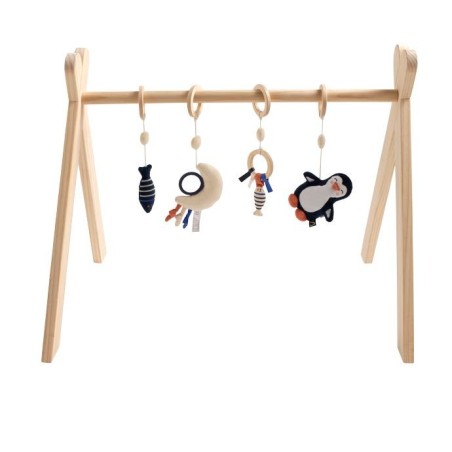
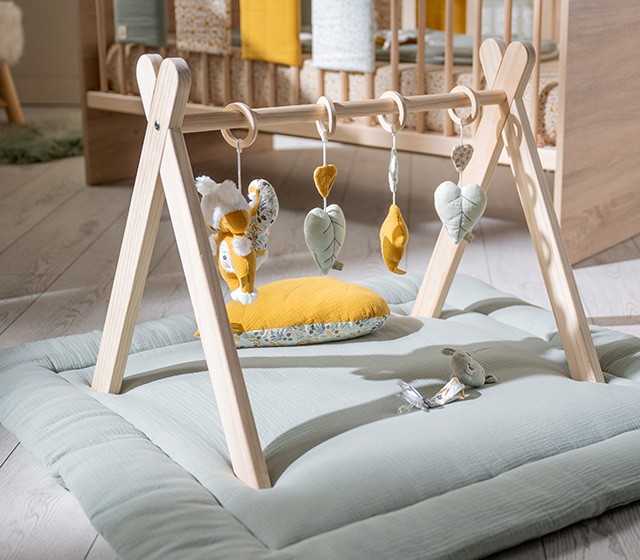
We often see the play gym positioned above the baby’s head. It attracts their visual and sensory attention with the different hanging objects. However, this position keeps the baby lying on their back, staring at the ceiling.
With this setup, your child is not engaging in free motor exploration and cannot experiment with rolling onto their left or right sides. Their head also remains still, which limits movement. Yet, one of the first expected motor skills is head movement to the right and left to release the first cervical vertebra. Since neuromuscular maturity is still developing, this posture can cause neck tension.
The lack of side movement and limited head mobility also increases the risk of developing plagiocephaly (a flattening and asymmetry of the back of the head).
But don’t worry — when used appropriately, the play gym can support your child’s sensory and motor development.
Let’s see how to use it effectively.
The play gym stimulates your baby’s visual system through the toys hanging above. It is best to choose high-contrast colors like black and white, or red and white, which especially stimulate the retina.
It also stimulates the sense of hearing. The gentle sounds from rattles (crinkling, squeaking, jingles…) grab your baby’s attention and create coordination between sight and hearing. This is called the audio-visual loop, and it is essential to a child’s development.
Try positioning the play gym on one side of your baby — either the right or the left. This encourages them to turn their head and body toward the toys, which helps develop side-to-side movement and early rolling.
By following the toys with their eyes, your baby also develops side-to-side and up-and-down eye movements, which are key for gaze stabilization and visual tracking.
From around 3 to 4 months of age, you can also place the play gym near your baby’s feet. This helps them discover the lower half of their body. They begin to move their pelvis, legs, and feet, and make connections between upper and lower body. They will enjoy seeing the toys move and hearing their sounds, making the connection between cause and effect (“when I kick, the toys move and make noise”).
How does the mobile stimulate your baby’s senses?
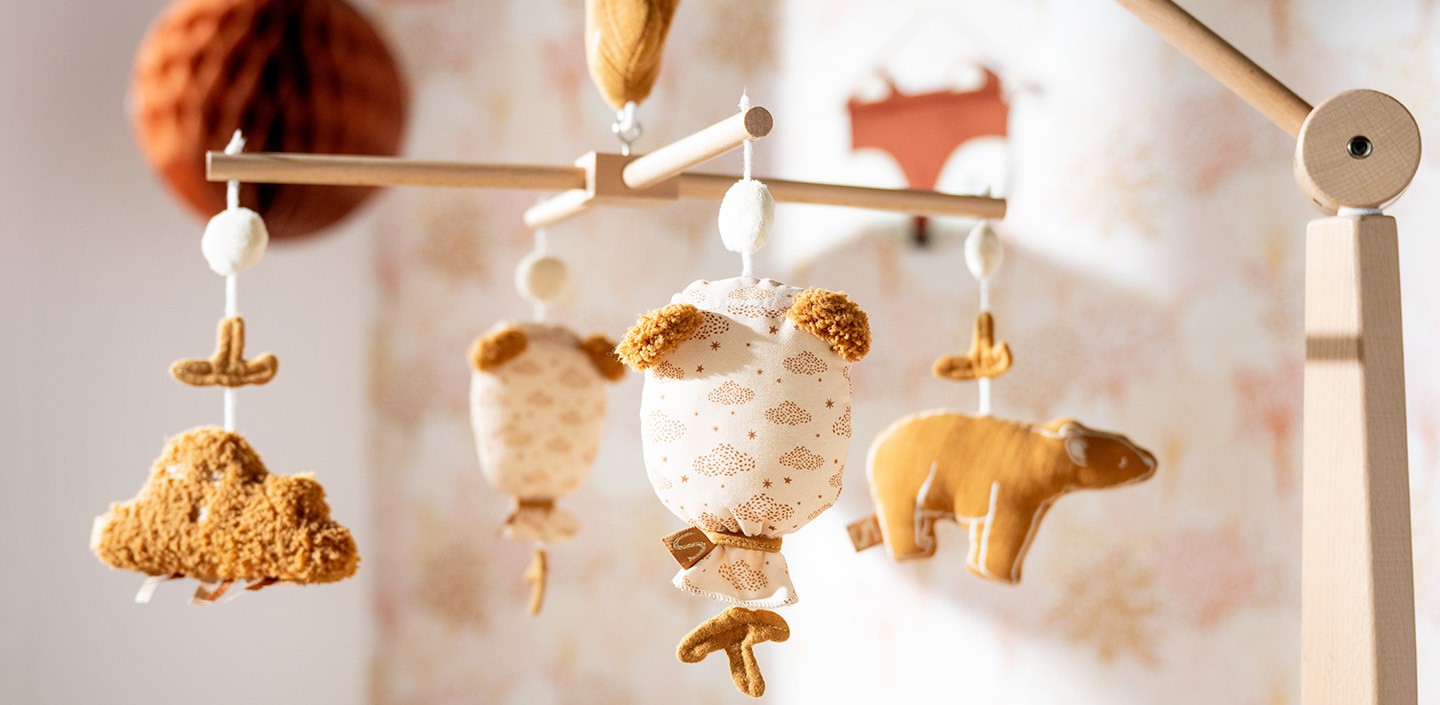
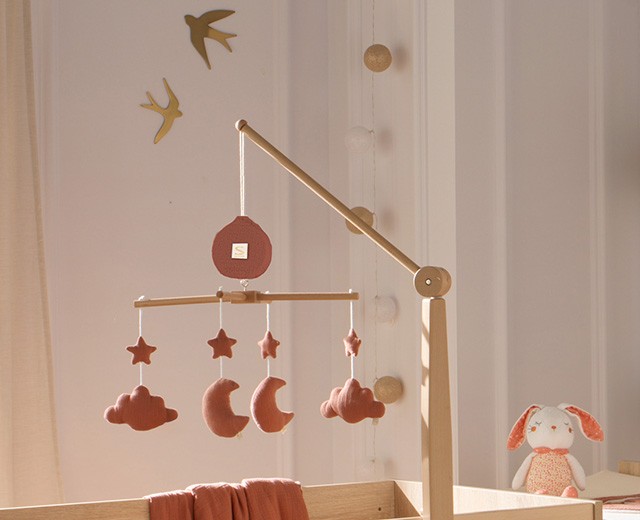
The mobile, like the play gym, stimulates both vision and hearing. But since the mobile is often placed above the crib for quiet, calming moments before sleep, it’s best to choose gentle stimuli to avoid sensory overload.
You can also use the mobile at other times of the day — in the morning while your baby waits in their bed, or when you need to safely occupy them while caring for another child.
The mobile will draw your baby’s gaze. Traditionally, it’s hung above the baby’s head, which again causes them to remain still and look upwards — posing the same plagiocephaly risk as the play gym.
To avoid this, place the mobile above the baby’s chest rather than the head. This better directs their gaze and allows more head movement, lowering the risk of flat head syndrome.
Now it’s your turn.
This article was written in collaboration with the Eveil&Conseil team to answer parents’ common questions and provide reliable guidance to help you care for yourself and meet your baby’s needs.
Eveil&Conseil is a collective of dedicated and passionate health professionals. Find all their advice and comprehensive support on their website www.eveiletconseil.fr or on their app, available on Google Play and the App Store.

check_circle
check_circle